



How much CFM does a sandblast cabinet need
How Much CFM Does a Sandblast Cabinet Need? (Complete Chart & Sizing Guide)
Wondering how much CFM does a sandblast cabinet need to run efficiently? Matching your air compressor output to your cabinet’s CFM requirement is the key to consistent blasting performance, clear visibility, and long equipment service life. On this page, you will find a detailed CFM chart by nozzle size, cabinet type recommendations, and a complete guide to sizing your sandblast cabinet air compressor.
As a general rule: standard suction sandblast cabinets require 28–42 CFM at 90 PSI with a 5/16" nozzle; direct pressure blast cabinets need 105+ CFM for heavy-duty work; and wet blast cabinets use around 53 CFM. For reliable long-term operation, always size your air compressor 1.5–2x the nozzle’s rated CFM to account for air line losses and continuous duty cycles.
1. Quick Reference: Sandblast Nozzle CFM Chart
Below are standard CFM requirements for common suction blast nozzles at 90 PSI working pressure, the most widely used configuration for cabinet sandblasting.
| Equipment Type | Model | Nozzle Size | Working Pressure | Air Demand (at 6 bar / 90 PSI) | Recommended Compressor | Typical Application |
|---|---|---|---|---|---|---|
| Dry Suction Blast Cabinet | TS9060A | 8 mm (5/16") | 6 bar / 90 PSI | 0.8 - 1.2 m³/min | 28 - 42 CFM | Small hardware derusting, small-batch processing |
| TS1010A | Industrial parts cleaning, mold surface treatment | |||||
| TS1212F | Large casting blasting, mass production | |||||
| Dry Pressure Blast Cabinet | TS-GY-9080B | 8 mm (5/16") | 6 bar / 90 PSI | 3.0 m³/min | 105+ CFM | Thick coating removal, heavy-duty blasting |
| TS-GY-1010B | High-efficiency blasting, large-scale production | |||||
| Wet Blast Cabinet | TS9065W | 9.5 mm (3/8") | 6 bar / 90 PSI | ~1.5 m³/min | ~53 CFM | Precision parts matting, dust-free processing |
| TS1010W | Medical/food parts, stainless steel treatment | |||||
| TS1212W | Large workpieces high-precision surface treatment |
Pressure Nozzle Air Consumption Reference (6bar)
| Nozzle Diameter | Air Consumption (Metric) | Air Consumption (CFM) |
|---|---|---|
| φ6mm (1/4") | 2.2 m³/min | ≈78 CFM |
| φ8mm (5/16") | 3.0 m³/min | ≈106 CFM |
| φ10mm (3/8") | 4.7 m³/min | ≈166 CFM |
* All CFM values are tested under standard 6 bar / 90 PSI inlet pressure with standard boron carbide nozzles. Actual consumption may vary by abrasive media and hose length.
Note: Pressure blast cabinets require 20-30% higher CFM than suction-type cabinets with the same nozzle size.
2. What is CFM?
CFM stands for Cubic Feet per Minute and measures the airflow volume delivered by an air compressor. In sandblasting operations, it defines how much compressed air is supplied to the blast nozzle per minute. Sufficient CFM ensures consistent abrasive velocity and stable blasting performance throughout operation.
3. Why CFM Is Critical for Sandblast Cabinets
Consistent Abrasive Delivery: The core function of a sandblast cabinet is to accelerate abrasive media to clean or prepare surfaces. Steady airflow ensures uniform abrasive feed and predictable finishing results.
Clear Operator Visibility: Proper airflow paired with the dust collection system removes airborne abrasive dust from the blasting chamber, preventing buildup on the viewing window and maintaining clear visibility for precise work.
Equipment Protection: Continuous sandblasting generates heat and puts a load on the compressor. Adequate airflow prevents the compressor from overworking and overheating, extending its service life.
4. Key Factors That Determine Your CFM Needs
To calculate the exact sandblast cabinet CFM requirement for your setup, consider these four main factors:
Nozzle Diameter: The single biggest factor. Larger nozzles consume significantly more air than smaller ones. Always size your compressor based on the largest nozzle you plan to use.
Blasting System Type: Pressure-feed cabinets require much more CFM than suction (siphon) blast cabinets, as they push abrasive directly from a pressurized pot.
Working Pressure (PSI): Higher operating pressure increases CFM consumption. Most industrial sandblasting runs at 80–100 PSI, with 90 PSI being the industry standard.
Abrasive Media Density: Heavier abrasives like steel grit require more airflow to accelerate than lighter media such as glass beads or plastic media.
A general rule of thumb for reliable daily operation: size your air compressor to deliver 1.5–2 times the nozzle’s rated CFM consumption. For example, a standard 5/16" suction blast nozzle that uses 28–42 CFM works best with a compressor rated for 42–84 CFM, to account for line losses and consistent duty cycles.
Safe Sizing Rule: Choose a compressor with 1.5–2x the nozzle’s rated CFM to cover air line losses, pressure drops, and continuous production use without airflow shortage.
5. CFM Requirements by Sandblasting Cabinet Type
Small Hobbyist Cabinets (5–15 CFM): Designed for light, occasional use with small parts and fine nozzles, suitable for home workshops and repair shops.
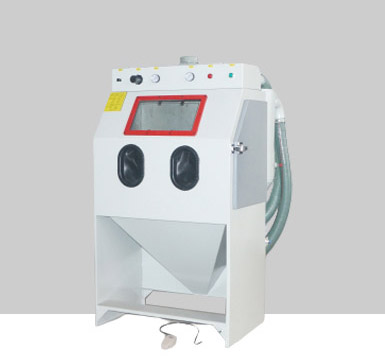
Medium Commercial Cabinets (15–30 CFM): The most common range for regular production and job shop work. Our standard suction sandblast cabinets (e.g., TS-9065 model) fall into this category, delivering reliable daily performance with a standard 1/4" nozzle.
Large Industrial Cabinets (30–100+ CFM): Built for heavy-duty, multi-shift production with pressure feed systems and large nozzles. Our industrial pressure blast cabinets and rotary table systems are engineered for this level of continuous operation.

6. How to Select the Right Air Compressor
When choosing an air compressor for sandblast cabinet use, always confirm it meets or exceeds your required CFM at the working pressure you will use. Follow these guidelines:
Check Rated CFM at Operating Pressure: Do not rely on peak or maximum CFM numbers. Verify the compressor’s rated CFM output at 90 PSI, the standard pressure for most cabinet blasting.
Prioritize Duty Cycle Rating: For production use, choose a compressor with at least 75% duty cycle, preferably 100% continuous duty. This prevents overheating and downtime during long blasting sessions.
Account for Air Line Losses: Long hoses, small pipe diameters, and fittings all reduce effective CFM at the nozzle. Size your compressor 20–30% larger than the minimum requirement to compensate.
Match Tank Size to Usage: Larger air tanks reduce compressor cycling and provide more consistent pressure. For regular commercial use, a minimum 60-gallon tank is recommended.
For daily production use, a rotary screw compressor with 100% continuous duty cycle is strongly recommended over reciprocating piston compressors, as it delivers stable CFM output during extended blasting sessions.
7. Risks of Running Insufficient CFM
Using a sandblast cabinet with an undersized compressor (too little CFM) leads to several predictable problems:
Slow & Uneven Blasting: Low airflow causes inconsistent abrasive velocity, resulting in uneven surface finishing and much longer processing times.
Poor Visibility & Dust Buildup: Weak airflow reduces dust collection efficiency, causing dust to accumulate inside the cabinet and obscure the operator’s view.
Premature Equipment Wear: An undersized compressor will run continuously and overheat, shortening its lifespan and leading to frequent maintenance and repairs.
8. Tips to Optimize Airflow Efficiency
Perform Regular Maintenance: Clean or replace air filters, drain moisture from the compressor tank, and inspect hoses for leaks. Even small air leaks can significantly reduce effective CFM at the nozzle.
Use Properly Sized Air Hoses: Use the largest diameter hose recommended for your nozzle, and keep hose length as short as possible to minimize pressure drop.
Match Abrasive to Your Setup: Use abrasives with consistent grain size and good flow characteristics to maintain steady feed and efficient airflow.
Operate at Optimal Pressure: Run at the lowest PSI that still achieves your desired finish. Higher pressure wastes air and wears out nozzles and cabinet liners faster.
9. Frequently Asked Questions
Q: Does hose length reduce CFM for sandblasting?
Q: What PSI is best for cabinet sandblasting?
Q: Is CFM different for wet blast cabinets?
Q: Can I use a smaller compressor for occasional use?
Q: How do you calculate CFM for a sandblast cabinet?
Q: What size air hose do I need for a sandblast cabinet?
Q: Can I use a 20-gallon air compressor for sandblasting?
Q: How much CFM does a 1/4" sandblast nozzle use?
Understanding the CFM requirements for your sandblast cabinet is essential for achieving optimal performance and long equipment life. By sizing your compressor correctly, selecting the right nozzle, and following proper maintenance practices, you will get consistent, high-quality surface finishing results with minimal downtime.
Not Sure Which Cabinet & Compressor Setup Fits Your Needs?
Our engineering team provides free custom sizing recommendations based on your workpiece size, production volume and finish requirements.
Get Free Sizing Consultation