




4 Steps to Choose the Right Sandblasting Machine and Abrasive
How to Choose the Right Sandblasting Machine and Abrasive: 4-Step Expert Buying Guide
This complete sandblasting machine buying guide walks you through a proven 4-step framework to select the perfect sandblasting machine and matching abrasive for your production line. The right equipment improves production efficiency and reduces long-term operating costs. The correct abrasive delivers consistent surface quality and minimizes rework. The wrong combination will drive up maintenance expenses, cause inconsistent finishing, and create avoidable production bottlenecks.
At TS Blasting, we have designed customized industrial surface treatment and sandblasting equipment selection solutions since 2007. We help manufacturers choose equipment based on actual production requirements rather than generic product specifications alone.
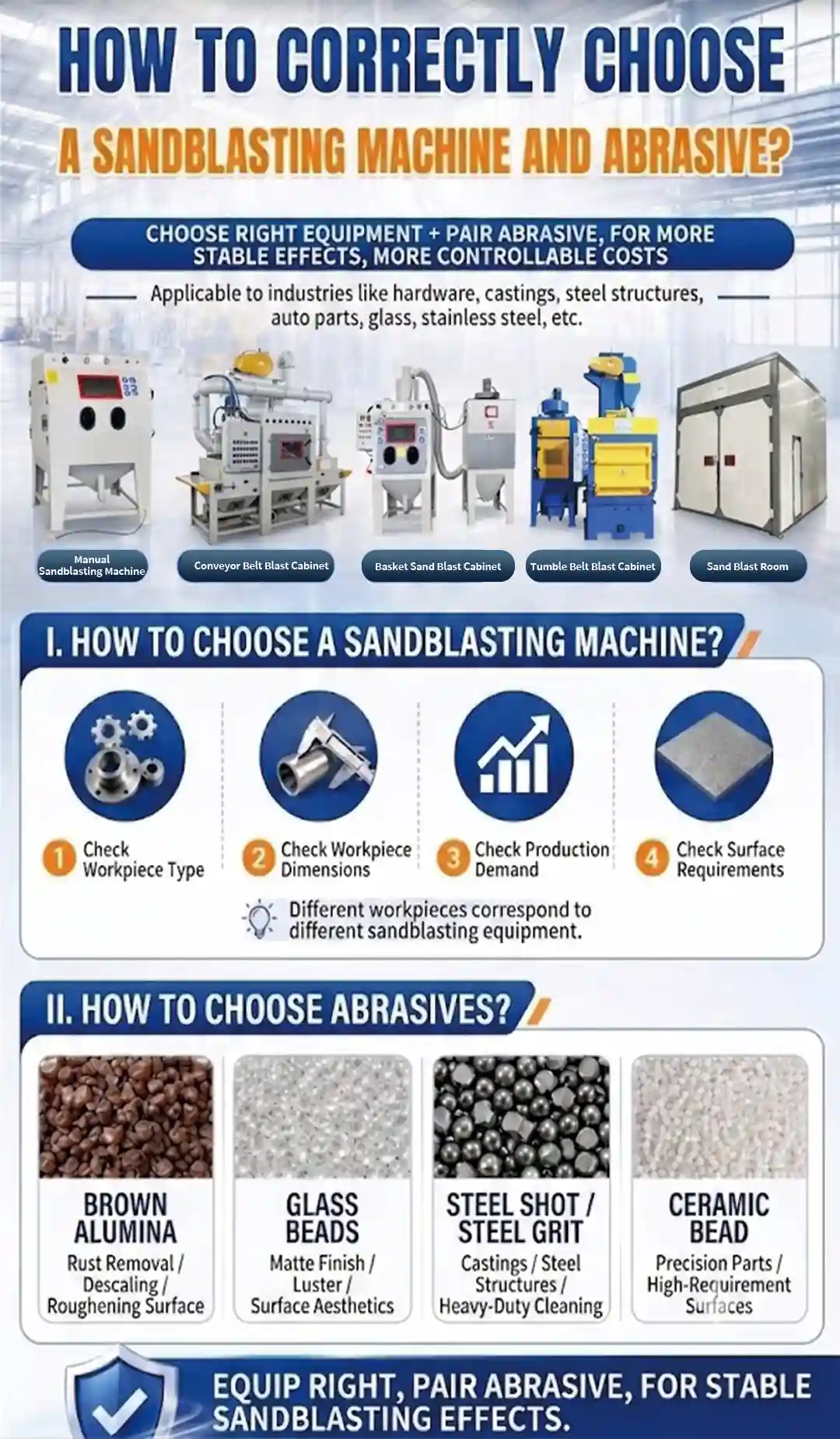
Use the infographic below to quickly grasp the core framework of sandblasting machines and abrasive selection. Of course, if you have more complex problems that you can't solve, you can contact our engineers for free professional assistance.
In This Sandblasting Machine Selection Guide:
Why Proper Sandblasting Machine Selection Matters
Low Productivity: Excessively long processing times can cause bottlenecks on the production line and delay order delivery.
Excessive Abrasive Consumption: Using the wrong media or inadequate recovery systems leads to unnecessary waste and higher operating costs.
Surface Defects: Incorrect pressure or media causes warping, uneven finishes, or embedded contaminants that require rework.
High Maintenance: Undersized dust collectors and rapid nozzle wear increase the replacement frequency and downtime.
Higher Labor Cost: More labor hours are required for manual rework and inefficient manual blasting operations.
Step 1: Evaluate Your Workpiece to Choose the Best Sandblasting Machine
Every successful surface treatment solution begins with the workpiece itself. The design of the equipment must be based on the physical and chemical properties of your parts. Consider the following factors for accurate sandblasting machine selection:
Material: Is it soft aluminum, hardened steel, fragile glass, or composite material?
Shape & Complex Geometry: Are there blind holes, deep cavities, or intricate threads that require precise blast angles?
Weight: Can the part be lifted by an operator, or does it require an overhead crane and heavy-duty turntable?
Industry Standards: Does the industry dictate strict aerospace, automotive, or medical-grade cleanliness and roughness requirements?
Case Study: An automotive customer recently needed to process precision aluminum housings. Originally considering a standard pressure blasting machine, our engineers analyzed the complex geometry and soft material, recommending a wet blasting cabinet instead. This adjustment eliminates surface defects and reduces abrasive consumption by 30%.
Quick Selection Tip: Start your sandblasting equipment selection by listing your 2–3 most common workpiece types and their core surface treatment goals. This eliminates 70% of unsuitable machine models at the initial screening stage.
Step 2: Match Workpiece Dimensions to the Correct Sandblasting Equipment
Size dictates the physical footprint and handling mechanism of your blasting equipment. Do not simply measure the largest part; consider the average dimensions of your highest-volume components when selecting your sandblasting cabinet.
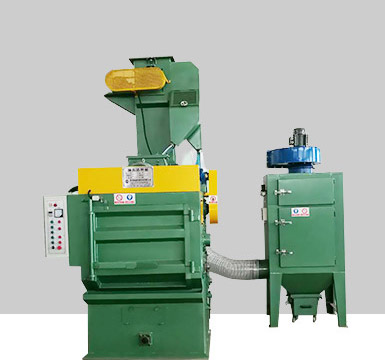
Small Parts (Screws, Fasteners, Small Brackets): Best suited for a Basket Sand Blast Cabinet or Tumble Belt Blast Cabinet where parts can be batch-processed automatically.
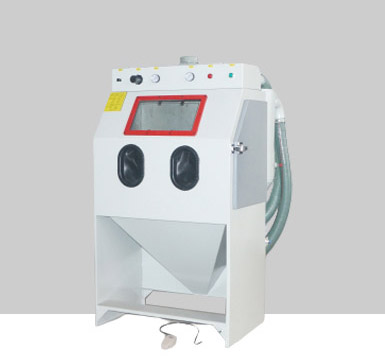
Medium Parts (Engine Blocks, Molds, Hubs): Ideal for a manual pressure or suction cabinet where operators can maneuver around the part for precise blasting.
Heavy Parts (Castings, Large Valves, Heavy Molds): Require a cabinet with heavy-duty motorized turntables or loading trolley systems for safe handling.
Long Flat Parts (Pipes, Extrusions, Aluminum Plates): Require a Conveyor Blast Cabinet or roller conveyor pass-through system for continuous processing.
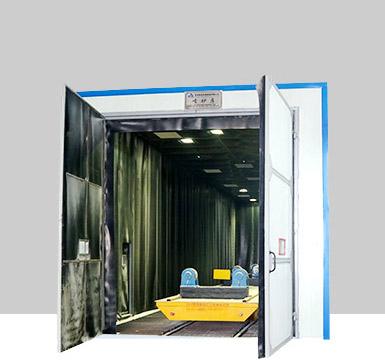
Oversized Structures (Steel Beams, Vehicles, Storage Tanks): Demand a dedicated Blast Room with specialized mechanical media recovery floors.
Not sure which sandblasting equipment fits your workpiece? Explore our full Sandblasting Machine Product Range, where you'll find detailed specifications, real machine photos, and typical application examples for every model.
Quick Selection Tip: Always select a cabinet with 15–20% more internal space than your largest workpiece. This ensures safe operator movement and uniform blast coverage across all part surfaces.
Step 3: Select Sandblasting Equipment Based on Your Production Volume
Your daily throughput determines the required level of automation. Match the machine to your production capacity. This helps you avoid paying for unnecessary automation. It also prevents production bottlenecks caused by equipment that cannot keep up with demand.
Prototype & Small Batch: Manual suction or pressure sandblasting cabinets require a low investment cost and can flexibly accommodate a wide range of small-batch production needs.
Medium Batch: Semi-automatic systems with turntables or simple robotic gun mounts balance labor costs with consistent output quality.
Mass Production & Continuous Batch: Fully automatic conveyor or pass-through blast systems are the most cost-effective choice for high-volume manufacturing.
When evaluating capacity, purchasing managers should analyze the Return on Investment (ROI) by calculating the initial investment against long-term labor, operating costs, and maintenance expenses. A higher upfront cost for an automated system often yields a faster ROI through reduced labor and closed-loop abrasive recycling.
Quick Selection Tip: If your production volume is growing steadily, choose a semi-automatic system that can be upgraded to full automation later. This protects your initial investment and supports future production expansion.
Step 4: Define Surface Finish Goals to Choose the Right Blasting Abrasive
The desired result dictates your choice of blasting media. Different applications require different approaches for optimal sandblasting abrasive selection:
Rust Removal & Paint Removal: Requires hard, angular abrasives to cut through heavy oxidation and thick industrial coatings.
Deburring: Requires media that can remove flash and burrs without altering the part's critical dimensional tolerances.
General Cleaning: Requires gentle, uniform media to remove dirt or carbon residue without etching the base metal surface.
Peening requires spherical media to impart compressive stress and improve the fatigue life of metal parts.
Matte / Decorative Finish: Requires fine, consistent media for an even, satin aesthetic appearance on finished products.
Coating Preparation: Requires angular media to create a uniform "anchor profile" for maximum paint or powder coating adhesion.
Quick Selection Tip: When in doubt, start with a medium-grit brown aluminum oxide for general metal work. It is the most versatile abrasive and works for most rust removal, deburring, and coating prep applications.
How to Choose the Right Sandblasting Abrasive Media for Your Application
Selecting the correct blasting media is just as critical as the machine itself. Use this reference table to match abrasives to your specific application:
| Abrasive | Surface Finish | Primary Application | Recyclability | Typical Industry |
|---|---|---|---|---|
| Glass Beads | Smooth, Satin, Bright | General cleaning, light deburring, shot peening | Medium | Automotive, Aerospace, Medical |
| Ceramic Beads | Smooth, Bright, Uniform | High-impact peening, precision cleaning | Very High | Aerospace, Precision Manufacturing |
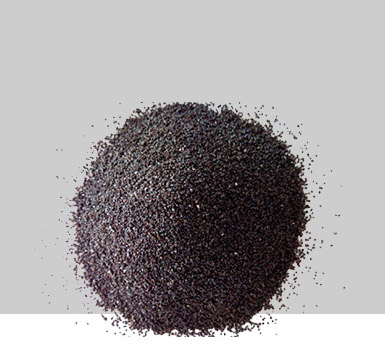
| Brown Aluminum Oxide | Matte, Etched, Uniform | Aggressive rust removal, heavy coating prep | High | Metal Fabrication, Surface Prep |
| Steel Shot | Smooth, Dimpled | Heavy shot peening, casting cleaning | Extremely High | Casting, Forging, Heavy Machinery |
| Steel Grit | Rough, Etched, Deep Profile | Heavy paint/rust removal, industrial coating prep | Extremely High | Steel Structures, Shipbuilding |
Why Global Manufacturers Partner with TS Blasting for Blasting Equipment & Abrasives
At TS Blasting, we focus on engineering reliable long-term solutions, not just selling machinery. We understand that industrial blasting equipment is a significant long-term production investment.
Proven Engineering Experience: Since 2007, we have designed over 50 patented customized surface treatment lines for the most demanding industrial applications. Our 10,000㎡ factory houses an 8,000㎡ production workshop and a team of 5 senior technical engineers.
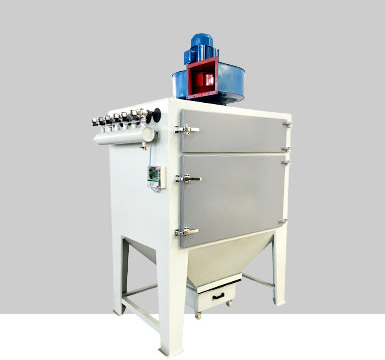
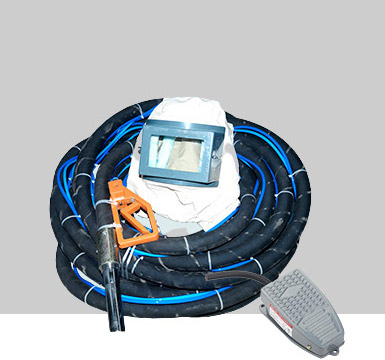
Complete Product Portfolio: We provide a full end-to-end ecosystem, including manual and automated blast machines, all types of abrasives, industrial dust collectors, and wear-resistant spare parts.
Custom Tailored Solutions: We engineer equipment built to match different industries, production capacities, and budget requirements, with fully customizable specifications.
Trusted Global Delivery:Our equipment is trusted in over 35 countries, with successful installations across the USA, Japan, the UK, Europe, Southeast Asia, and the Middle East.
Lifetime After-Sales Support: We partner with you for the full lifecycle of your machine, providing installation guidance, operator training, rapid spare parts delivery, and remote technical troubleshooting and maintenance advice.
Industry-Specific Sandblasting Equipment & Abrasive Recommendations
Surface treatment requirements vary wildly by sector. We design solutions adapted to the strict quality and safety standards of:
Automotive & Mold Components: Achieving exact surface friction for brake components, cleaning engine blocks, and peening transmission gears for extended fatigue life.
Steel Structure & Fabrication: Removing mill scale, heavy rust, and old paint from large I-beams and fabricated structures to ensure optimal paint adhesion and coating longevity.
Casting & Forging: Aggressively removing foundry sand, scale, and flash from heavy iron and steel castings using automated tumble and spinner hanger systems.
Medical Devices: Utilizing clean, iron-free environments and fine abrasives to create hygienic, glare-free matte finishes on surgical instruments and implant components.
Energy Equipment: Prepping large valves, pipes, and turbine components for extreme-environment anti-corrosion coatings in the oil, gas, and wind power sectors.
Construction Machinery: Processing large, heavy-duty excavator arms and chassis components before industrial powder coating and painting.
Optical Components: Etching and frosting glass surfaces with highly uniform, fine abrasives in automated pass-through production systems.
Electronics: Gently deflashing delicate PCB components and cleaning semiconductor manufacturing equipment without altering precise dimensional tolerances.
Frequently Asked Questions About Sandblasting Machine Selection
What size sandblasting cabinet do I need?
Your cabinet size depends on the largest workpiece you process, plus 15–20% of extra space for operator maneuvering and blast gun movement. For small batch parts like fasteners, a 900×600mm basket or tumble cabinet works well; for large molds or heavy parts, choose a turntable cabinet or custom blast room. Always reference your average production volume alongside maximum part size.
What is the best abrasive for rust removal and paint stripping?
For heavy rust removal and thick paint stripping, brown aluminum oxide or steel grit are the most effective options, thanks to their angular, aggressive cutting profile. For lighter rust or surface cleaning on delicate parts, glass beads provide a gentler finish without damaging the base material.
Should I buy a suction or pressure sandblasting cabinet?
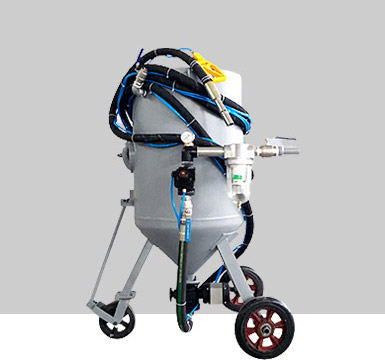
Suction blast cabinets are ideal for light-duty cleaning, small parts, and low-volume production, with lower upfront cost and simpler maintenance. Pressure blast cabinets deliver higher blasting force and faster processing speed, making them better suited for heavy-duty rust removal, thick coatings, and medium-to-high production environments.
How much CFM does a sandblasting cabinet require?
CFM requirements depend on nozzle size and cabinet type. A standard suction cabinet with an 8mm boron carbide nozzle typically needs 1.5–2.5 m³/min (53–88 CFM) at 6 bar pressure. Pressure cabinets and automated systems require higher airflow, usually 3–8 m³/min (106–283 CFM). You can reference our complete CFM guide for sandblast cabinets for detailed calculations.
Final Tips for Your Sandblasting Machine Buying Decision
Every manufacturer has different production goals. Equipment selection should match actual workpieces, production capacity, surface quality requirements, and future expansion plans. Choosing the cheapest blasting cabinet often leads to unexpected production bottlenecks, whereas a properly engineered system pays for itself through reduced labor, saved abrasive costs, and consistent flawless finishes.
Need Expert Engineering Advice for Your Sandblasting Machine Selection?
The TS Blasting engineering team can help you evaluate your specific workpieces, throughput demands, and surface finish requirements to recommend a complete, optimized surface treatment solution.
Contact TS Blasting Engineers